Wednesday, 13 May 2015

A review of Murder Most Unladylike by Robin Stevens

It’s amazing to think that a girl’s boarding school in the 1930s could sound quite so much like the prep school I attended at the very beginning of the Twentieth Century, but it seems like some of the these values will always be engrained into parts of the British education system. I did find it eerily coincidental that the book includes a character called Felicity and that I had a games teacher called Mrs Hopkins when I was at school, too. Fluke details aside, I think that everyone, children and adults alike, will find something they can relate to in this very easy going novel. We might not all be the daughters of Lords or find ourselves in a different country miles away from our families, but we do all know what it feels like to be an outsider trying to fit in.

The story is told from the point of view of Hazel Wong, a foreign student who gradually becomes part of the institution herself. We’ll forgive the author for choosing a name which sounds an awful lot like Hazel’s country of origin, Hong Kong. There is a lot more to her characterisation than being purely an Asian stereotype.

There is a strong anti-bulling message which is refreshing to see in books for children and comforting to read to as an adult. The book promotes all sorts of lessons to its readers: women can be strong; children can know as much as adults do; it’s not ok to persecute others for being different; you should never be afraid to stand up to your friends and things may not always be as they seem. That’s quite a lot of moral messaging to cram into a relatively short murder mystery!


Murder aside, this representation of school in England is not one which every reader will immediately recognise. The boarding school rhetoric and the sheltered bubble in which the girls live is not an accurate portrayal of the average education in Britain. But not all fiction needs to be entirely representative. There is a sense of nostalgia in the text, and the boarding school setting makes it much more likely that Wells and Wong’s Detective Society could actually prosper.

I grew up reading Enid Blyton and JK Rowling and my fictional escapism was often located in boarding schools in the country. The experiences of these children were always wildly different from my own but that’s why I enjoyed reading the books. I want to avoid saying that Murder Most Unladylike is Malory Towers meets Sherlock Holmes, it is much more than that, but I can’t get the image of Daisy and Hazel running around in deerstalkers and hiding drawing pins on teachers’ chairs out of my head.

It’s not a gritty, hard-hitting novel which deals with the injustice of the education system in Britain, but it is jolly good fun and a very entertaining read. I will certainly be buying the next books in the series.

Sunday, 10 November 2013

The Magic of Stories

W B Gooderham has recently published a book called ‘Dedicated To’. This book is a collection of the annotations and inscriptions found lurking beneath the covers of second hand books. Sadly, since I am currently living in Mexico and Amazon.com has yet to reach us out here, I have no way of getting hold of a copy any time soon, but I cannot wait to look inside.

I have been a fan of stories ever since I can remember. We still have bookshelves lined with the stories that I was told and that I read myself when I was too young to have many of my own. As I grew up, I fell in love with telling stories. I joined a drama club and I took part in the physical retelling and communication of stories live in front of audiences. I had fierce nightmares because my brain wouldn’t dare stop telling stories even when I was asleep.

I grew up more, and began to study literature. To understand the art of the story, the science of the story. I also study language and the art of communicating those stories. When I moved to Mexico, my family came to visit and my Dad said to me that he wasn’t surprised that my Spanish had improved dramatically in a short space of time because he knew that I wouldn’t be able to survive if I couldn’t communicate my stories to others.

And for all of these reasons I love the second hand bookshop. For me it is the perfect image of the story. Not the book. The story. Because second hand books tell more than just the story written in their pages. They hold in their chapters the imprint of somebody’s life. The person who owned that book read that story, and in some way, however large or small, it will have affected them. There must be a story behind how they got the book, whether they read and why they let it go. As with any story the possibilities are endless, and we will never know for sure exactly how these stories unfolded. But for me it doesn’t matter. The story lives on in the book, which may pass from reader to reader, generation to generation in a strange immortalising of not just a chapter in a novel, but in a chapter of someone’s life.


For me WB Gooderham’s recent publication offers an insight into this secretive, mysterious world of the dual-story potential of second hand books. And I cannot wait to begin my story by buying it. 

Saturday, 19 January 2013

Boris Godunov, 9th January, Swan Theatre, Stratford-Upon-Avon

Boris Godunov forms the second part of this season’s A World Elsewhere trilogy at the RSC and marks Michael Boyd’s last production as Artistic Director. The first ever production of Pushkin’s little-known play in English, is by no means a weak exit for Boyd.

Lloyd Hutchinson as Boris Godunov – photograph by Ellie Kurttz


He was of course the man who brought us the memorable histories which began the Complete Works Festival, and echoes of this epic cycle are visible throughout the performance. The play itself works in much the same way as the histories, in that it tells the story of an earlier period of Russian history. The script has blood, treachery, death, deceit and treachery, pretty much everything you would expect in a history play. In a question and answer session with a selection of actors and the Assistant Director of the show, Lloyd Hutchinson described the play as ‘a love letter to Shakespeare’ and there are notable references to many of his works, including Julius Caesar, Henry V, Richard III and Coriolanus.

But Boris Godunov offers something unique from these plays: it has comedy. Whilst some of Shakespeare’s denser works offer a few moments of humour in the course of the production, Adrian Mitchell’s adaptation features comedy from beginning to end. Somehow it cleverly combines physical and verbal comedy on stage with tragedy, so that one minute you are laughing, which Boris sat in the stalls with his arm round the shoulder of an audience member and the next minute you are mourning the death of his men in combat. Boyd capitalises on the comedy in the script and creates physical comedy on stage too. My particular favourite moment was the creation of the fountains where Grigory arranges to meet Maryna. The fountains consisted of four women standing with bowls on their heads, and the moving water was made by men pouring it out of jugs into the bowls. This ingenious staging created the sound and effect of fountains on stage but maintaining a comedic undercurrent to the business transactions playing out in the scene.

The actors were, as always, fantastic. But particular mention must go to Lloyd Hutchinson in the title role as Boris, who shone out as an incredible performer, who kept the audience onside at every moment. Another special mention goes to Lucy Briggs-Owen as Maryna, whose interpretation of a neurotic and scheming princess rivalled any portrayal of the spoilt daughter of a king.

Boyd managed to stage a production which was incredibly entertaining, informative and clever in so many ways. But it also serves as a comment on modern day Russia. Towards the end of the play, the actors change from old fashioned military uniforms into smart modern suits, with guns instead of knives, and smart phones and earpieces to complete the look. Boyd has made an entertaining production with an extremely relevant political overtone. Shakespeare would be proud.

Boris Godunov is followed by A Life of Galileo which I imagine will be just as impressive as this production. Be sure not to miss out.

Wednesday, 19 December 2012

My personal highlights of the National Gallery, Trafalgar Square, London

On arrival at the National Gallery in London, an incredible building in itself with its famous columns and steps, I was offered the opportunity to hire an audio guide for the duration of my visit. The audio guide, incidentally, is well worth getting. For just £3.50 (£2.50 for concessions) you are given commentary on most of the sights that the National Gallery has to offer. This was, for me, well worth the money since the admission is free in the first place. The guide came with a leaflet taking you through a 60-minute quick tour of the highlights of the gallery’s exhibits. This leaflet, however, I would ignore entirely.

Well perhaps ‘entirely’ is unfair. It certainly tells you where to find the works of the biggest names and the paintings which we have all seen in countless reproductions. If these famous ‘masterpieces’ are what interest you then the leaflet gives you a great route through the gallery.

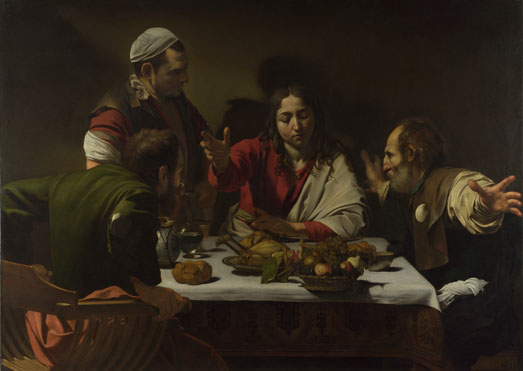
The Caravaggio on display, The Supper at Emmaus, is as technically brilliant as all of his works, but as the daughter of a seasoned Caravaggio enthusiast I have seen his works exhibited all over the world, and I think it is safe to say that the National Gallery does not possess one of his greatest.
Michelangelo Merisi da Caravaggio: 'The Supper at Emmaus'

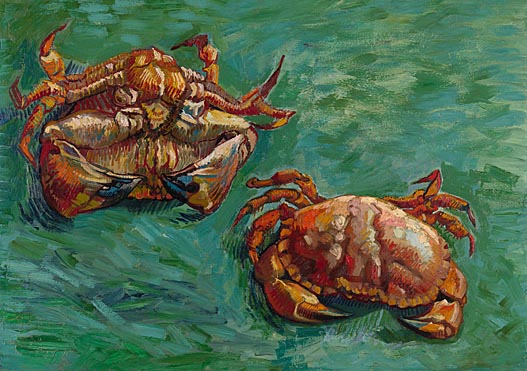
It is of course amazing to see such iconic works as Van Gogh’s Sunflowers in their original form; they almost always surpass expectations. I am not personally a huge fan of Van Gogh in general and it certainly wasn’t his sunflowers which caught my gaze. Instead I was much more attracted to his still life of Two Crabs whose orange shells set against a brilliant blue-green background really appealed to me. It seemed to display much more technical skilled than his other works.
Vincent van Gogh: 'Two Crabs'

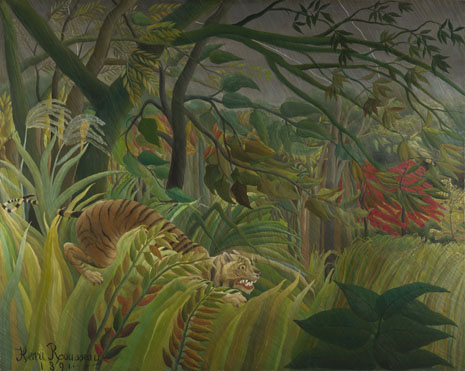
Of all the ‘big names’ on display though, it was Rousseau’s Surprised! which really blew me away. The famous tiger in the jungle is so much bigger than I have ever imagined and therefore much more impressive. The lashing rain and the tropical storm in the background are much more obvious in the original and really add an extra dimension to the painting.

Henri Rousseau: 'Surprised!'

For me though, part of the beauty of wandering around an art gallery is the waiting for something to catch your eye and to surprise you. It was the pictures I’ve never seen before, by artists I’ve never heard of which I found the most exciting. If you let yourself wander out of the main network of rooms and inter the smaller corners of the gallery you will find the small closet-like spaces in which hang just 4 or 5 paintings. Tucked away in these corners you’ll find some real treasures and the peace and quiet to really enjoy them.

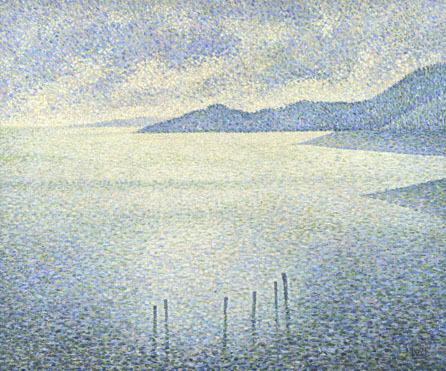
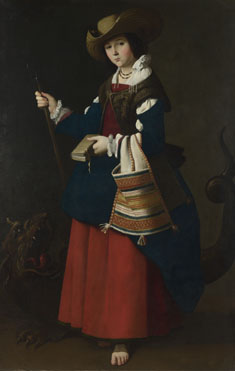
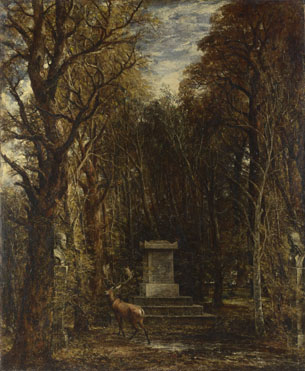
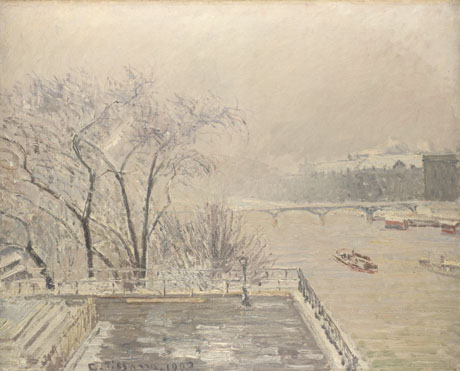
Shown below are just a few of my personal highlights of the National Gallery and are in my opinion well worth a visit. Most of them also have an audio guide entry which will explain the painting and the artists in more detail than the paper plaques next to the pieces themselves.

Théo van Rysselberghe: 'Coastal Scene'


Francisco de Zurbarán: 'Saint Margaret of Antioch'


John Constable: 'Cenotaph to the Memory of Sir Joshua Reynolds'


Camille Pissarro: 'The Louvre under Snow'


Monday, 27 August 2012

Apethorpe Library

This small village has its library inside an old telephone box. I want one!!!

Sunday, 26 August 2012

'The Comedy of Errors', RSC, Stratford-Upon-Avon - 25th August 2012


Having never read, studied or watched the play before there was very little that I knew about it before walking into the theatre last night to watch the RSC’s current production of ‘The Comedy of Errors’. This meant that I had no preconceived notion of how the play should have been done and no benchmark to compare the production to. I was a very impressionable audience member but I feel that even a lover of the play as a text and as a production could not help but fall in love with this production.
I was blown away by the set. The RSC’s imagination seems to know no bounds and they have made no exception for this production. A huge rusty crane hangs over the stage and parts of the stalls way up in the gods and the front part of the stage contains real water with broken decking around the edges. Barrels, crates and sacks completed the illusion of the busy dockyard and Dromio and Antipholus’s (of Syracuse) first entrance was made inside a crate which came swinging along the crane and was dropped on to the stage.
I think plays are made by their openings. You can tell whether a production is going to be good or great within the first few seconds. This particular production of Shakespeare’s comedy opened in complete darkness, you could hear movement on stage but it was impossible to see where the actors were. When the lights went up, Egeon’s head was being forcibly held under 6 inches of water in a fish tank by an armed guard. It was one of the most striking openings to a play I have seen in a long time and from that moment on, I knew that this production would be one I would not regret seeing.
The acting was exceptional as always, both sets of twins were fantastic but special mention has to go to the two Dromios, played by Felix Hayes and Bruce Mackinnon, who not only looked incredibly similar (all credit to the wardrobe department) but all of their movements and characteristics were mirrored by each other to the extent that context alone told the audience which one was which. Jonathan Slinger, an actor who has bowled me over dozens of times in his performances at the RSC, appeared on stage for all of 3 minutes but was utterly fanastic (as ever) in his role as sadistic Dr Pinch, sent to cure Antipholus and Dromio of their ‘madness’. The sparks flying from the jump leads used to electrocute the protagonists made for a horrifying concept, the execution however was incredibly funny, with some ridiculous reactions from Felix Hayes and Stephen Hagan. My highlight of the show however had to be Kirsty Bushell’s portrayal of Adrianna. Her performance flicked between crazed eccentricity, hopeless desperation, violent rage and giddy delusion to create a character which was utterly compelling to watch.
All in all, this is a fantastic production and definitely worth a watch. So maybe the stage violence is completely unbelievable at times and it is slightly hard to believe that the two Anitpholus’s are even related, let alone identical twins but the acting is incredible, the set is stunning and the production will have you laughing from beginning to end.